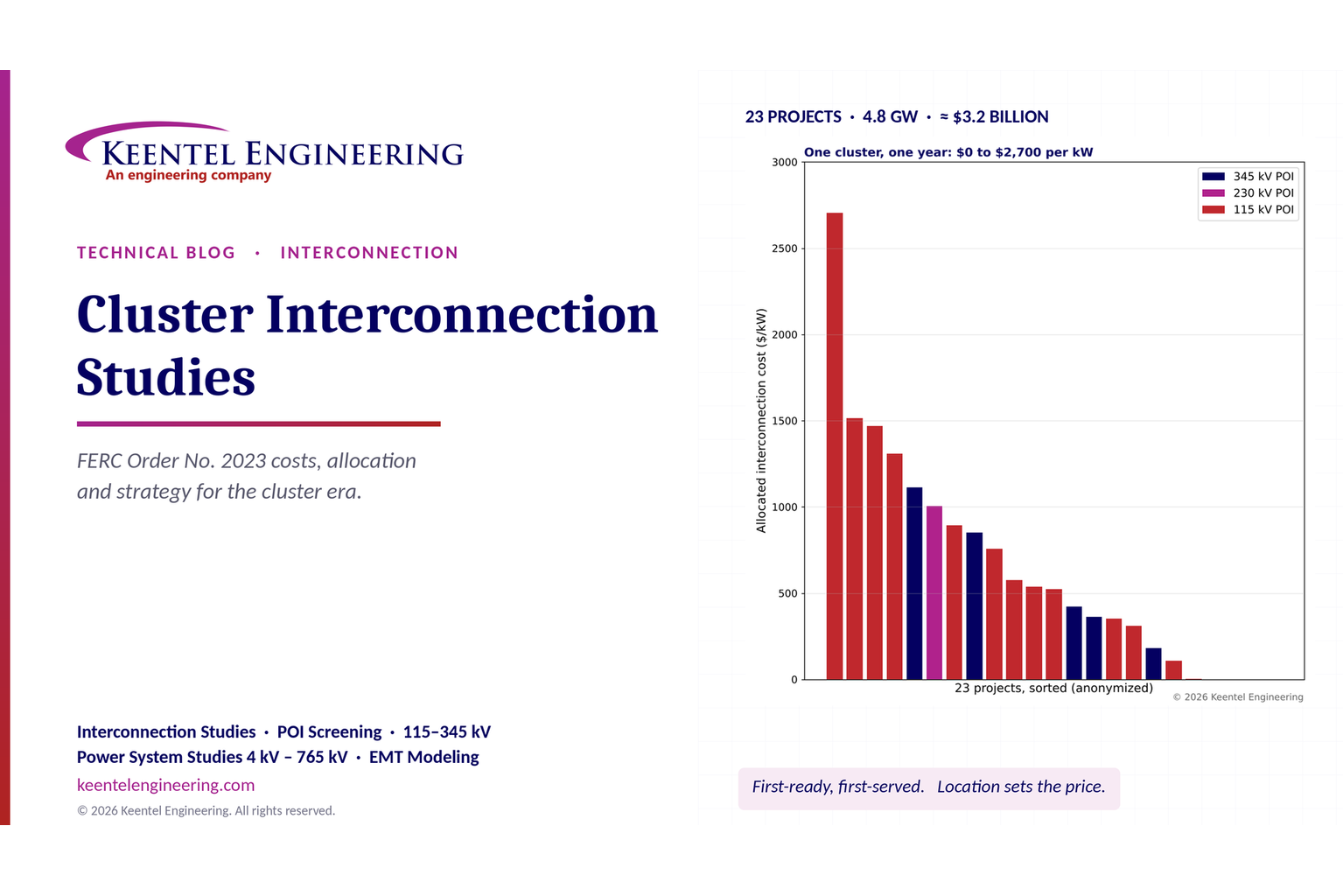


A Coordinated Electric System Interconnection Review—the utility’s deep-dive on technical and cost impacts of your project.
Challenge: Frequent false tripping using conventional electromechanical relays
Solution: SEL-487E integration with multi-terminal differential protection and dynamic inrush restraint
Result: 90% reduction in false trips, saving over $250,000 in downtime
| Category | Metric |
|---|---|
| VPP capacity (Lunar Energy) | 650 MW |
| Lunar funding raised | US$232 million |
| Data center BESS example | 31 MW / 62 MWh |
| ERCOT grid-scale batteries | 15+ GW |
| LDES tenders (H1 2026) | Up to 9.3 GW |
| Lithium-ion share of LDES by 2030 | 77% |
| FEOC initial threshold | 55% |
| BESS tariff rate (2026) | ~55% |
| Capacity gain from analytics | 5–15% |
SCADA System Design for Collector Substations in Large Renewable Power Plants Complete Engineering Guide for Utility-Scale Solar, Wind, and BESS Facilities By Keentel Engineering
Feb 21, 2026 | blog
1. Introduction
Designing the SCADA system for a collector substation in a large renewable power plant is no longer a simple matter of connecting relays to an RTU. Modern renewable facilities especially utility-scale solar, wind, and battery energy storage systems (BESS)require:
- High-speed communications
- Secure cyber architecture
- Redundant networking
- Grid operator compliance
- Advanced inverter monitoring
- Real-time dispatch capability
- NERC CIP-aligned design
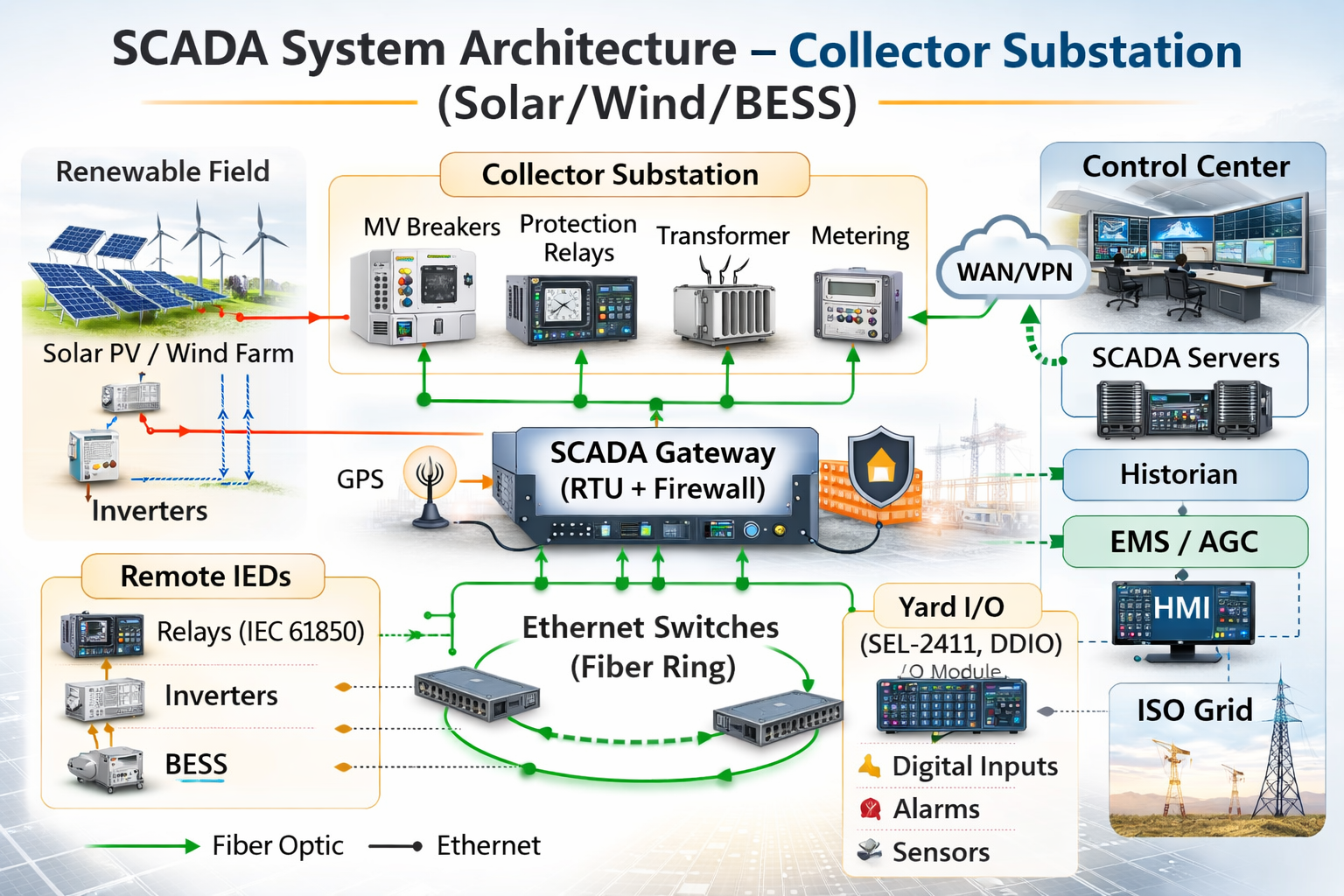
In a 300 MW solar plant or a 250 MW wind farm, the collector substation becomes the digital brain of the facility. Every inverter, feeder breaker, transformer, protection relay, metering device, and environmental sensor feeds into the SCADA architecture.
At Keentel Engineering, we design SCADA systems not just for monitoring but for grid-code compliant, secure, high-availability control of renewable generation assets.
2. Functional Architecture of Substation SCADA
A SCADA system implements two primary functions:
2.1 Data Acquisition
This includes collecting:
- Breaker status (52a/52b)
- Transformer temperature and LTC position
- Feeder currents and voltages
- Relay alarms and trip records
- BESS state of charge (SOC)
- Inverter output data
- Revenue metering
- Station service monitoring
- Fire alarm & environmental inputs
In renewable plants, total data points can exceed:
- 15,000 – 40,000 digital/analog points
- 200+ IEDs
- 100+ inverter communication nodes
All this data must be:
- Polled
- Time synchronized (GPS/NTP/PTP)
- Validated
- Buffered
Transmitted securely to:
- ISO control center
- Owner’s remote O&M center
- PPC (Plant Power Controller)
- AGC system
2.2 Supervisory Control
Supervisory control includes:
- Breaker open/close commands
- Transformer LTC control
- BESS dispatch commands
- Feeder sectionalizing
- Remote reset of relays
- Reactive power control
- Curtailment commands
In renewable plants, supervisory control is tightly integrated with:
- ISO AGC signals
- Volt/VAR control
- Frequency response
- Ramp rate limits
- Ride-through logic
This makes SCADA design significantly more complex than traditional substations.
3. Data Concentrator / Gateway Design
Modern collector substations utilize:
- RTU + Gateway combination
- Or multifunction SCADA gateway device
Examples include:
- SEL RTAC
- GE D400
- NovaTech Orion
- Schweitzer SEL-3555
Core Requirements:
- Sufficient Ethernet & fiber ports
- Serial ports (if legacy devices exist)
- Protocol conversion capability
- Firewall functionality
- VPN capability
- Redundant power supplies
- NERC CIP compliance support
4. Communication Protocol Strategy
Collector substations must support multiple protocols simultaneously:
| Device | Protocol |
|---|---|
| Protection Relays | IEC 61850 MMS / DNP3 |
| Legacy relays | Modbus RTU |
| ISO communication | DNP3 Secure Authentication |
| Inverters | Modbus TCP |
| Revenue meter | DNP3 / IEC 61850 |
| BESS EMS | Modbus TCP |
| Engineering access | HTTPS / SSH |
Preferred Modern Architecture:
IEC 61850-based station LAN with GOOSE messaging
Benefits:
- Peer-to-peer messaging
- Faster trip schemes
- Reduced copper wiring
- Scalable architecture
Keentel Engineering strongly recommends IEC 61850 for new collector substation projects.
5. To Network or Not to Network?
The diagram you shared highlights a critical design decision:
Option A: No Station LAN
- Direct connect IEDs to gateway
- Suitable for small substations
- Lower cybersecurity complexity
- Limited scalability
Option B: Build Station LAN
- Install managed Ethernet switches
- Fiber ring topology (RSTP or PRP)
- VLAN segmentation
- Redundant architecture
For large renewable plants (>50 MW), a station LAN is mandatory.
6. Cybersecurity and NERC CIP Alignment
If the collector substation qualifies as:
- BES Cyber System
- Critical Asset
Then SCADA must include:
- Electronic Security Perimeter (ESP)
- Firewall configuration
- Role-based access
- Audit logging
- Patch management strategy
- Remote access controls
- Multi-factor authentication
Keentel Engineering designs SCADA architecture compliant with:
- NERC CIP-002 to CIP-013
- IEEE 1686
- IEC 62351
7. Fiber Network Architecture in Renewable Plants
Large solar plants may include:
- 200+ inverter pads
- 10–20 collector feeders
- Multiple fiber loops
Recommended topology:
- Redundant fiber ring
- Managed Layer 3 switches
- Separate VLANs for:
- Protection traffic
- SCADA traffic
- Engineering access
- CCTV
8. Handling Yard Inputs (Hardwired vs Network)
The diagram references:
- Bringing alarms/status inputs from yard?
If YES:
Install:
- SEL-2411
- Orion DDIO
- Distributed I/O modules
Used for:
- Transformer gas alarms
- Fire suppression alarms
- Gate open detection
- Intrusion detection
Modern approach:
- Use distributed Ethernet I/O modules instead of large hardwired marshalling panels
9. Redundancy and High Availability
Collector substations should include:
- Dual SCADA servers
- Redundant gateways
- Dual fiber paths
- Dual power supplies
- Redundant GPS clocks
For 300 MW plants, 99.99% availability is required.
10. Integration with Plant Power Controller (PPC)
In renewable plants, SCADA integrates with:
- PPC (Plant Power Controller)
- EMS (Energy Management System)
- AGC system
SCADA provides:
- Real-time MW/MVAR
- Breaker availability
- Transformer status
- Fault indication
PPC sends:
- Reactive power setpoint
- Power factor command
- Curtailment limit
- Ramp rate instructions
11. Engineering Deliverables by Keentel Engineering
Our SCADA design package includes:
- SCADA architecture diagram
- Network topology drawings
- Fiber routing layout
- I/O point list (Excel + mapping)
- Protocol mapping sheets
- Firewall configuration philosophy
- Control logic documentation
- HMI screen layouts
- NERC compliance documentation
- Factory Acceptance Test (FAT) procedures
- Site Acceptance Test (SAT) procedures
12. Why SCADA Design in Renewable Plants Is Critical
Poor SCADA design can lead to:
- ISO penalties
- Curtailment issues
- NERC violations
- Communication failure
- Lost revenue
- Protection miscoordination
In renewable energy, SCADA is revenue protection.
Conclusion
Designing SCADA for a collector substation in a large renewable power plant is not just about connecting relays it is about designing a secure, scalable, grid-compliant digital infrastructure.
At Keentel Engineering, we specialize in:
- Utility-scale renewable SCADA architecture
- IEC 61850 design
- Protection & Control integration
- NERC compliance engineering
- ISO telemetry integration
- High-availability digital substations
If you are developing a solar, wind, or BESS project and need expert SCADA design — contact Keentel Engineering today.
25 Technical FAQs – Collector Substation SCADA
1. What is the primary difference between RTU-based and IEC 61850-based SCADA?
IEC 61850 enables peer-to-peer communication and reduces hardwiring, while RTU-based systems rely more on centralized polling.
2. When is a station LAN mandatory?
For substations >50 MW or with more than 20 IEDs.
3. What redundancy level is recommended?
Dual redundant gateways and fiber rings for plants >100 MW.
4. Should inverter data be routed directly to ISO?
No. It should pass through plant-level SCADA for aggregation.
5. Is DNP3 Secure Authentication required?
Yes for most ISOs.
6. How many data points can a large solar plant have?
Up to 40,000.
7. What is the role of GPS clock?
Time stamping SOE events within 1 ms accuracy.
8. How is cybersecurity boundary defined?
Using Electronic Security Perimeter per NERC CIP.
9. What is PRP vs RSTP?
PRP is zero-recovery redundancy; RSTP has small convergence time.
10. Can distributed I/O replace hardwired panels?
Yes, significantly reduces wiring.
11. How is breaker control secured?
Two-step select-before-operate logic.
12. What protocols are common for BESS?
Modbus TCP and DNP3.
13. What is PPC interface?
Modbus TCP or ICCP.
14. Should revenue meter connect directly to ISO?
Often yes via secured gateway.
15. What is typical SCADA polling rate?
2–4 seconds for analog, 1 second for critical points.
16. How is event recording handled?
Buffered at relay level and gateway level.
17. Is VLAN segmentation necessary?
Yes for cybersecurity.
18. Can SCADA perform local automation?
Yes using gateway logic engine.
19. How to handle firmware updates?
Through secure maintenance window.
20. How to integrate fire alarms?
Via distributed digital input modules.
21. What ISO compliance affects SCADA?
ERCOT, PJM, CAISO telemetry requirements.
22. How are large point lists managed?
Using automated template mapping tools.
23. Is cloud SCADA recommended?
Not for primary control.
24. What testing is required?
FAT, SAT, point-to-point testing, failover testing.
25. Why choose Keentel Engineering?
Because we combine:
- Protection expertise
- Renewable interconnection experience
- NERC compliance knowledge
- Cybersecure architecture design
- Utility-grade documentation

About the Author:
Sonny Patel P.E. EC
IEEE Senior Member
In 1995, Sandip (Sonny) R. Patel earned his Electrical Engineering degree from the University of Illinois, specializing in Electrical Engineering . But degrees don’t build legacies—action does. For three decades, he’s been shaping the future of engineering, not just as a licensed Professional Engineer across multiple states (Florida, California, New York, West Virginia, and Minnesota), but as a doer. A builder. A leader. Not just an engineer. A Licensed Electrical Contractor in Florida with an Unlimited EC license. Not just an executive. The founder and CEO of KEENTEL LLC—where expertise meets execution. Three decades. Multiple states. Endless impact.
Services

Let's Discuss Your Project
Let's book a call to discuss your electrical engineering project that we can help you with.

About the Author:
Sonny Patel P.E. EC
IEEE Senior Member
In 1995, Sandip (Sonny) R. Patel earned his Electrical Engineering degree from the University of Illinois, specializing in Electrical Engineering . But degrees don’t build legacies—action does. For three decades, he’s been shaping the future of engineering, not just as a licensed Professional Engineer across multiple states (Florida, California, New York, West Virginia, and Minnesota), but as a doer. A builder. A leader. Not just an engineer. A Licensed Electrical Contractor in Florida with an Unlimited EC license. Not just an executive. The founder and CEO of KEENTEL LLC—where expertise meets execution. Three decades. Multiple states. Endless impact.
Leave a Comment
We will get back to you as soon as possible.
Please try again later.